
Flexible Air Duct Selection Guide: How to Choose Diameter, Insulation and Material
A technical guide to selecting flexible duct diameter, insulation and material using airflow, design velocity and installation conditions.
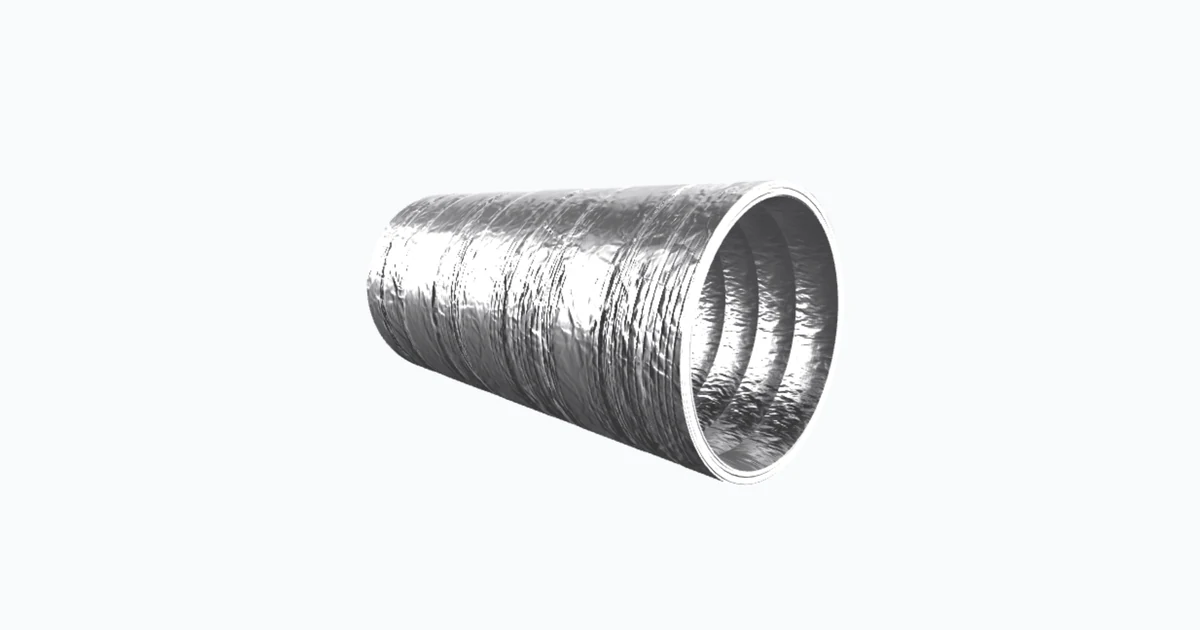
What is a flexible air duct and where is it used?
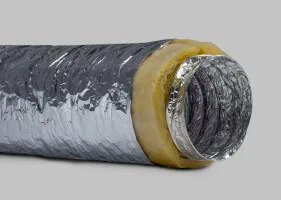
Flexible air ducts are bendable air-conveying components that retain their form with spiral wire or similar reinforcement. They are widely used at diffusers, grilles and air terminals in residential, commercial and hospitality HVAC systems. Long, compressed or tightly bent runs can increase pressure losses.
1. How is air duct diameter determined?
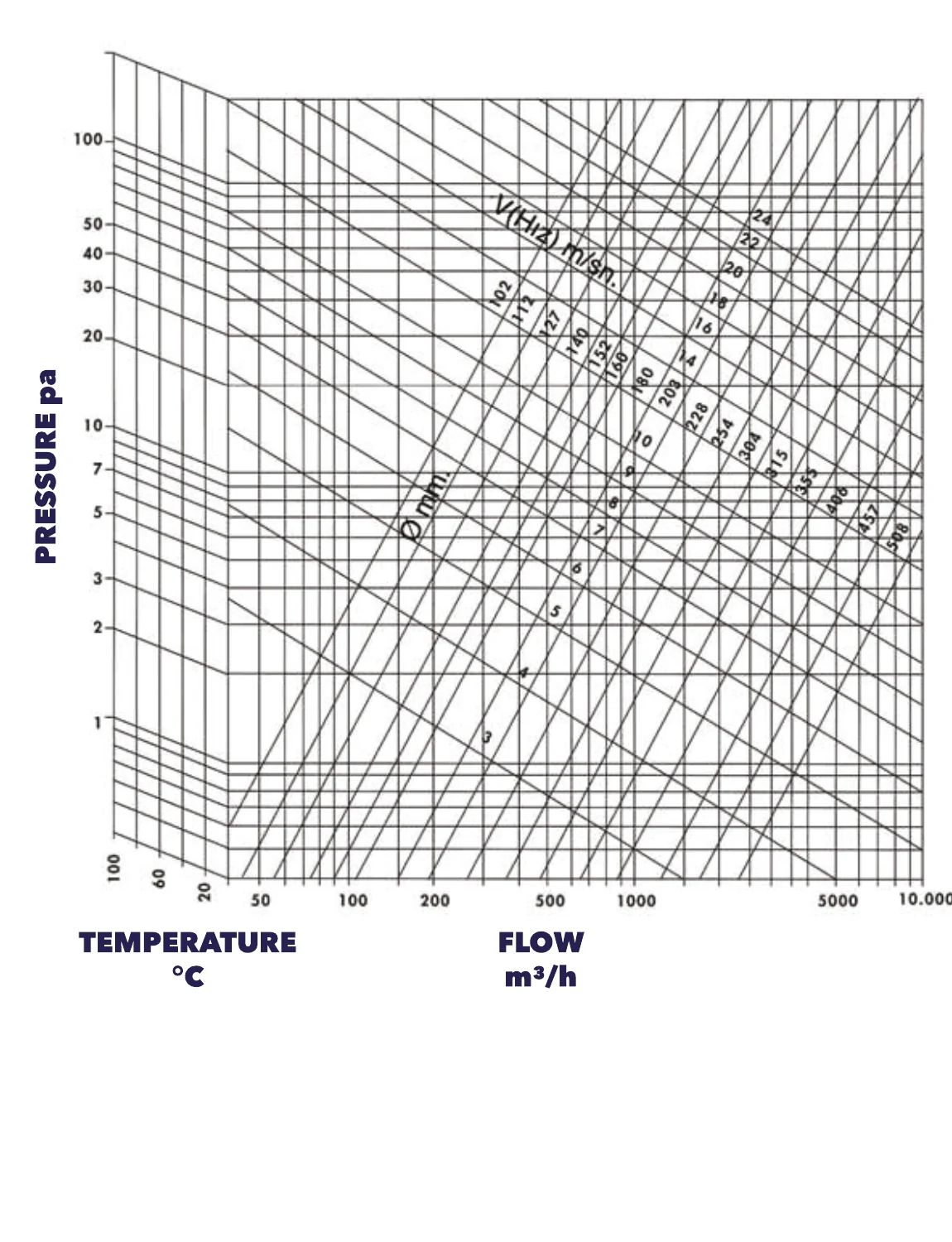
Start with the required airflow (m³/h) and design air velocity (m/s). For preliminary sizing of a round duct use Q = A × v × 3600 and A = π × d² / 4. Final selection must also consider the fan curve, run length, bends, acoustic goals and manufacturer pressure-loss data.
| Ø | 3 m/s |
|---|---|
| Ø100 mm | 85 m³/h |
| Ø125 mm | 133 m³/h |
| Ø150 mm | 191 m³/h |
| Ø160 mm | 217 m³/h |
| Ø200 mm | 339 m³/h |
| Ø250 mm | 530 m³/h |
| Ø315 mm | 842 m³/h |
Values are geometric calculations at 3 m/s, not rated product capacities or a universal design recommendation.
Flexiva pressure-loss and duct-sizing diagram
2. Insulated or uninsulated?
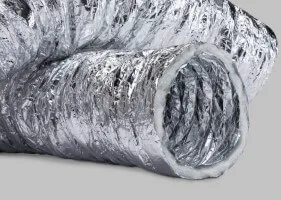
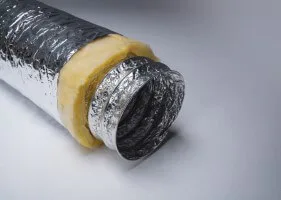
An uninsulated duct has no additional thermal layer and may provide a more compact solution. Insulated duct can help limit heat transfer and condensation when carrying conditioned air. Select thickness by considering air and ambient temperatures, relative humidity, thermal conductivity, vapour-barrier continuity and dew point.
Insulated versus uninsulated flexible duct
| Selection criterion | Uninsulated duct | Insulated duct |
|---|---|---|
| Construction | Flexible inner duct | Flexible inner duct, insulation layer and outer jacket |
| Typical selection context | Short internal connections with low heat-transfer and condensation risk | Conditioned-air routes where heat transfer or condensation needs control |
| Primary distinction | More compact and lightweight construction | Construction that can help limit heat transfer and, when correctly designed, condensation risk |
| Checks required | Temperature, pressure, air velocity, reaction to fire and installation conditions | The same checks plus insulation type/thickness, thermal conductivity, vapour-barrier continuity and dew point |
This is a general selection summary. Confirm the final choice through project calculations, ambient conditions and the selected product data. Reference: Flexiva Product Catalogue, product constructions and insulation section (pages 12–49).
3. Insulation and duct materials
Glass wool, fibre, elastomeric rubber and polyethylene differ in thermal, moisture and application behaviour. When comparing aluminium/polyester, PVC and composite ducts, consider conductivity, thickness, reaction to fire, temperature, abrasion and static electricity. No single material is universally best.
4. Sono and hygienic models
Sono models may attenuate sound at certain frequencies; actual performance depends on tested product data and installation. Surface or antimicrobial properties of hygienic models do not replace filtration, cleaning and the overall hygiene design.
5. Reaction to fire, pressure and temperature limits
Verify operating temperature, maximum velocity, positive/negative pressure suitability, airtightness and reaction-to-fire classification for the exact variant. M0, M1 and EN 13501-1 are different systems and are not direct equivalents. Reaction to fire is not system fire resistance.
6. Common installation mistakes
Unnecessarily long runs, crushed ducts, tight bends, inadequate supports, leaking joints and damaged insulation can reduce performance. Install ducts short and properly extended, following the manufacturer instructions and project specification.
Conclusion: select for the technical duty
Correct selection is more than matching a diameter. Airflow and pressure loss must be assessed together with insulation, material, temperature, acoustics and fire requirements.
Verified product comparison
| Product | Construction | Insulation | Feature | Temperature range | Max. air velocity | Max. operating pressure | Diameter range |
|---|---|---|---|---|---|---|---|
| Flexiva VENTUS Elyaf İzoleli | Aluminium + Polyester (inner duct and outer jacket) | Fibre | Flame retardant (M1) | -30 °C / +150 °C | 30 m/s | 5.000 Pa | Ø102–356 mm |
| Flexiva AIR İzoleli | Aluminium + Polyester (inner duct and outer jacket) | Glass wool | — | -30 °C / +80 °C | 30 m/s | 5.000 Pa | Ø76–610 mm |
| Flexiva SKY İzoleli | Aluminium + Polyester (inner duct and outer jacket) | Glass wool | Flame retardant (M1) | -30 °C / +150 °C | 30 m/s | 5.000 Pa | Ø76–610 mm |
Values are manufacturer-declared maximum operating limits, not recommended design conditions.
View products
FAQ
How do I select a flexible air duct diameter?
Use airflow and design velocity for preliminary sizing, then verify length, bends, pressure loss and manufacturer data.
Is an insulated duct always required?
No. An uninsulated duct may suit routes with low heat-transfer and condensation risk.
Is a Sono duct completely soundproof?
No. Attenuation depends on frequency, tested product performance and installation.
Contact the Pulat sales team to select a product for your project airflow, route and operating conditions.
Quick Contact
Contact us directly through your preferred channel.